
Recursive, Until the Power Bill
Lawrence Lundy’s State of the Future: Dispatch from 5th June 2026

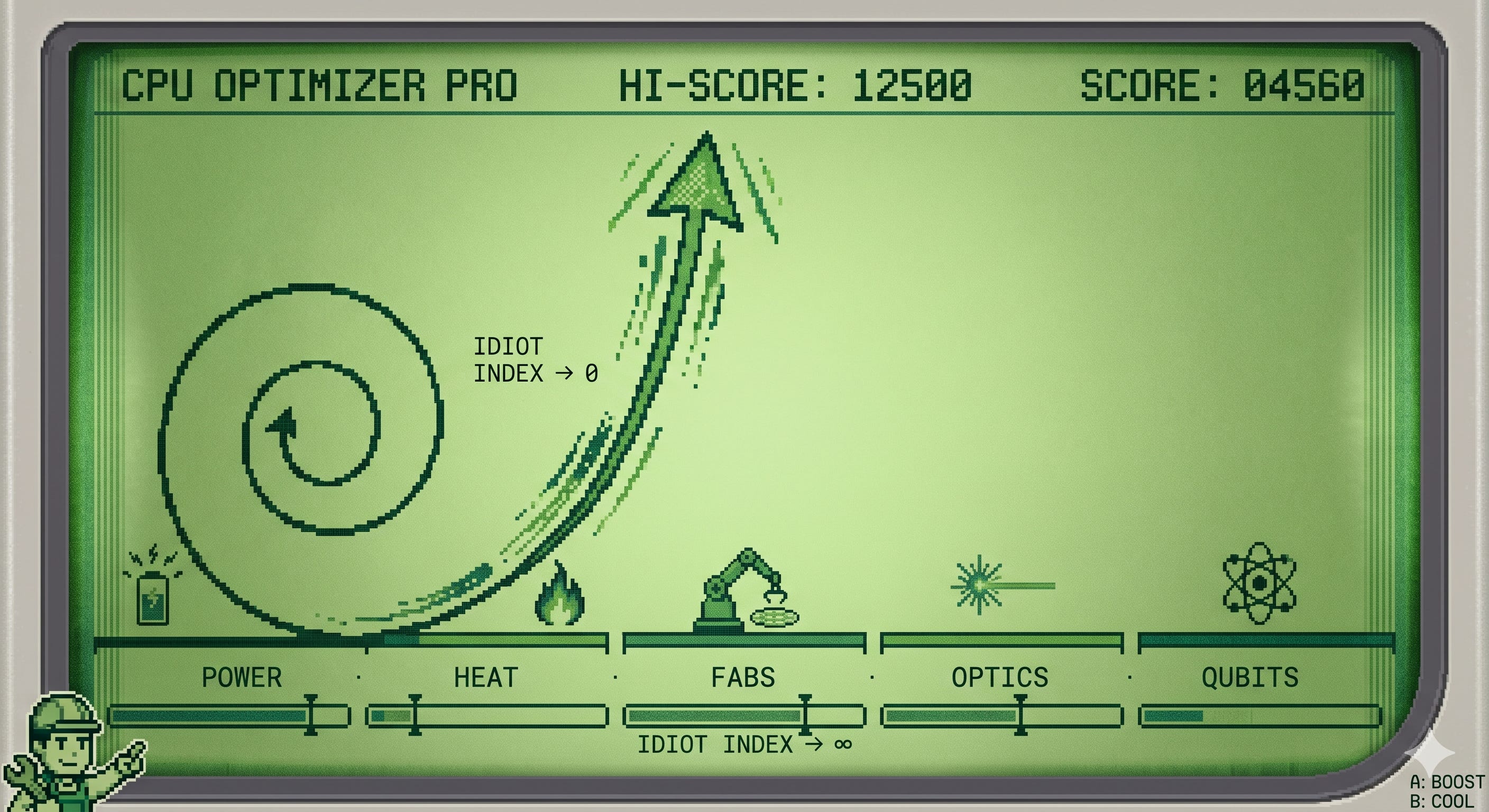
I’ve been reading Sam Harsimony’s Splitting Infinity this week, a piece on the technologies he’s skeptical of, there’s a lovely bit of accounting he calls the idiot index: the ratio of what a finished thing costs to what its raw materials cost. For most things the raw inputs are tiny, and the rest, land, equipment, financing, thermodynamics, is the part that won’t budge however clever/rich you get. He calculates rocket fuel bottoming out near $55 a kilo. A person outputs about 10 bits a second whatever you bolt to their skull. It’s good stuff. You can disagree with assumptions and input costs, but it’s a good exercise for you/claude to do.
I was primed with this idiot index when reviewing this weeks’ stories, with the concept of recursive self-improvement. Software’s idiot index is basically nothing now, the marginal cost of more code rounds to zero, so of course it improves itself, of course the flywheel spins. But the atoms and electrons underneath it, power, heat, fabs, optics, has a savage idiot index and concrete physical floors. AGI won’t solve that even if we have robotics and nanoassembly. Generating, moving and detecting atoms, electrons and photons will always have a cost, and likely an increasingly large share of the cost.
But still, I mean, despite the costs, recursive self improvement will be pretty important.
1. The last invention that man need ever make
“When AI Builds Itself” is Anthropic’s argument that recursive self-improvement, the model getting good at building the next model, could arrive before anyone’s ready. As per last week though, I think whenever it arrives it will be before anyone’s ready. Well Blair will be ready of course. He’s always ready.
The idea’s older than the field of AI. In 1965, 3 years before HAL turned up, I.J. Good, a Bletchley cryptographer who’d worked with Turing, described an “intelligence explosion”: a machine clever enough to design machines builds a better one, which builds a better one, and away it goes. He called the first one “the last invention that man need ever make”, with a caveat that’s aged well, “provided the machine is docile enough to tell us how to keep it under control”. That sat in sci-fi and seminar rooms for 60 years, Vinge, Bostrom, a decade of Yudkowsky arguing fast versus slow takeoff online. But now we really are close?! If someone tells me this is PR for the IPO, so help me god…
More than 80% of the code Anthropic merges is authored by Claude as of May. They’re plotting their models on METR’s time-horizon metric, the length of task a model can finish solo. We are heading to weeks by 2027 team. This is your weekly reminder.
So they’d like the option, their word, for the world to be able to slow or pause frontier development, labs verifying each other have actually stopped. The lab fastest at building itself asking for the brake.
Where i’d push back is the usual place. All this self-improvement still has to run on something physical. “Just build more substations”. Maybe, but i don’t buy the grid moves at model speed, and the more I look the more it’s power and heat that caps this by 2027, not model cleverness, not chips (the energy-is-destiny drum I was banging in April). Well actually, once the memory bottleneck is solved, it will be litho.
Source: Anthropic | METR. Background: The Compute Gradient, Sep 2025, on power as the real scaling variable.
2. The Machine That Builds the Machine
Good’s machine needed better hardware to run on, the part he hand-waved. Well, NVIDIA. Two announcements this week. It started shipping Spectrum-X co-packaged-optics (CPO) switches, built with TSMC, to select partners. 400 terabits a second on TSMC’s COUPE photonic packaging. And it put its own compute inside TSMC’s fab, cuLitho doing the mask work, claiming 20-50% on computational lithography (their figure). So the chips that train the AI are now partly designed by AI and wired together with light. The loop closes.
CPO, quickly: today the optics that turn electrons into light sit in a pluggable module at the edge of the switch. Called “pluggables” I don’t know why. And at these speeds the electrical signal can’t survive the few centimetres of copper to reach it without burning power and falling apart. Co-packaged optics bonds the optical engine right next to the switch chip instead. So you get shorter copper, less power per bit, more bandwidth, etc et al. It’s the interconnect, not the chip, that’s the data-centre wall now. But you already knew that. Buy copper.
NVIDIA is one of many here though. Broadcom (AVGO) has been shipping its Bailly CPO switches since 2024, 50,000+ through 2025, with a 102-terabit next-gen sampling now. So what’s NVIDIA’s $2bn into Coherent (COHR) and Lumentum (LITE) buying? Supply. Marvell (MRVL) also bought Celestial AI for up to $5.5bn in December for the same reason. The whole optical supply chain’s being bid up at once. I called the photonic engine for the interconnect back in February. This is just the start. We will likely need multi-material PDKs soon….
Source: Focus Taiwan | Broadcom. Background: Photonic Engines for Data Centers, Feb 2026.
3. Quantum?
And quantum for the palate cleanser. If AI moves too fast to track, let’s try something that moves so slow, it might literally never arrive.
IBM this week said it will spend >$10bn over 5 years to build a fault-tolerant machine called Starling “promised” for 2029. Yes yes, from the guys that brought you Watson. But the interesting bit is what they announced alongside it: Anderon, a standalone company they’re calling the first pure-play quantum wafer foundry, and the money isn’t quite what the headline suggests. It’s $1bn from the US Department of Commerce under CHIPS, matched by $1bn of IBM’s own cash, plus IP, assets and people on top. Call it $2bn all in. Albany and300mm, pitched as multi-vendor.
And also this week, 2 European quantum rounds: Oxford Quantum Circuits in the UK, £260M, the biggest private quantum round Europe’s done, the British Business Bank anchoring £100M. And Quobly in France, €115M, led by STMicroelectronics, silicon-spin qubits on bog-standard FD-SOI 300mm wafers.
Quick summary so you don’t have to claude: “quantum computer”.
Superconducting (IBM, Google, OQC, Rigetti) runs loops of current near absolute zero, furthest along, needs dilution fridges.
Trapped-ion (IonQ, Quantinuum, Oxford Ionics) holds atoms in electromagnetic fields, lovely fidelity, slow.
Neutral-atom (Pasqal, QuEra, Atom Computing) does similar with lasers and scales nicely.
Photonic (PsiQuantum, Xanadu, Quandela) runs light through silicon photonics, room temperature, fibre-native.
Silicon-spin (Quobly, SemiQon, Diraq, Quantum Motion, Intel) puts the qubit in something close to a transistor, the newest and the most fab-friendly.
Diamond NV (Quantum Brilliance, SaxonQ) parks the qubit in a nitrogen-vacancy defect in diamond, runs at room temperature, rugged and portable, better at sensing than scale so far.
Topological (Microsoft) bets on Majorana modes that are meant to be error-resistant in the hardware itself, gorgeous on paper, not quite demonstrated in practice.
Quantum annealing (D-Wave) isn’t a gate machine at all, optimisation only, but it’s the one that’s actually been shipping and selling for over a decade.
Electrons-on-helium (EeroQ) floats qubits on the surface of liquid helium, about as niche as it gets, early but charming.
The tell in IBM’s announcement is the foundry. $10bn is just money; building your own wafer fab from scratch tells you the capital load superconducting carries. And IBM isn’t the only one reaching for silicon — back in January IonQ bought SkyWater, the US foundry, outright for ~$1.8bn, to lock in a captive onshore wafer line. Two routes to the same instinct: IBM building greenfield 300mm as a multi-vendor pure-play, IonQ buying an existing fab and making it captive. The thing worth noting is that IonQ is trapped-ion, supposedly one of the lighter-capex approaches, so when even they decide they need to own the silicon, it says something about how much fab access is worth.
Which makes me think the fab-friendly architectures, silicon-spin and photonics riding a standard wafer line, have a structural edge: free use of the whole semiconductor industry’s capex. So it’s vertical integration (capex heavy, higher profit) versus horizontal integration (low capex, lower profits). Pick your fighter. My bet is low capex wins by 2030, though the IonQ move is a swerve, and my own knowledge base flags this as contested. Harsimony up top would tell you quantum’s oversold; on breaking encryption he’s right, post-quantum crypto got there first, but the $10bn’s betting the rest is worth a foundry.
Source: Quantum Insider | The Next Web. Background: Qubits in a Fridge, Dec 2024, on silicon spin and why a normal fab matters.
4. The Machine Web
Finally, and short because of the quantum primer above. Cloudflare’s Matthew Prince says bots have passed humans on the web for the first time, 57.5% of requests across their network automated against 42.5% human. In March, at SXSW, he’d said the crossover was a 2027 problem. It came 18 months early. The agents, as I have written, have arrived.
Caveat: it’s HTTP requests on one network, not time or attention, so it isn’t “57% of reading is robots”. But the direction is the consumer-web version of the agent shift, single chatbot calls giving way to fleets of agents. Question what is the bottleneck: orchestration or raw tokens? Quick answer: energy.
The obvious winner here, if there is one, is Cloudflare (NET), which is pushing pay-per-crawl, a toll on the bots that it’d happen to collect. Bot-detection and any “prove you’re human” layer get more valuable from here too. Get your agents to track ZKP more closely and do a sourcing run on founders. Also, what happens to an ad-funded web when most of the traffic is machines that never see an ad? Does a toll actually hold, or do the labs just route round it through residential proxies?
Source: Tom’s Hardware | The Decoder. Background: You Like AI Agents?, Feb 2025.
What else I’ve been reading
I mentioned Sam Harsimony’s Splitting Infinity up top.
1 + 1 = −1, inside a crystal. Physicists watched two lattice vibrations combine and spin the opposite way, forced by the crystal’s symmetry. Angular momentum, going backwards. ScienceDaily
Thermodynamics always ruins the party.
It is my understanding that the silicon or photonic type qbits have much harder QEC requirements than the superconducting ones.