
The Next VC Meme Is...
Lawrence Lundy’s State of the Future: Dispatch from 9 July 2026

The UK can once again be the most dynamic country in the world.
How many of us today believe that is possible? That despite the cynicism, this country is special.
That our history should be a source of confidence, when so much progress in science, institutions, and culture began on these shores. And that instead of fighting over how to redistribute the present, we should be building an incredible future.
His palms are sweaty, knees weak, arms are heavy. There's vomit on his sweater already, mom's spaghetti”
This is from my friend Andrew! Get involved! https://ukdynamism.fund

LFG Andrew! The vibes are good with this one.
At the start of my so-called career I had an assumption. Do the work. Do the research. VTOL aircraft, nuclear fusion, small modular reactors, fully homomorphic encryption. Pig organ transplants. Robot frogs. You get it. Form an opinion on whether the theme or frog is investable: market size, customer interviews, patent analysis, etc and you build a thesis. The type of company you’re looking for, the entry point, where the value gets captured. Like a good boy. That’s a lovely 12-pager you’ve got there, be a shame if AI commoditises it one day.
Do the work. Oh look, value will be captured at the die-level cooling not the heat spreader or TIM level because of the buyer behaviours. Source. Invest.
But was that ever right? Was I naive? Is that the best way to make money? Or just follow the money?
It’s not insightful to say capital moves mimetically. I already wrote about this: Consensus Capital. Maybe it was right once, maybe social media changed it, maybe now the frontier is atoms rather than bits, everything costs more. capital has to be marshalled into specific companies, and specific companies receive the bulk of it.
I’ve been in the 3 rooms where i’ve seen the rotation:
Crypto in 2014, which went from a niche weird thing geeks did to a sad thing scammers did, but for a stretch every tier-one was making crypto bets, Sequoia included, because a VC’s job is to bet on the future and nobody’s smart enough to know which future, so you take multiple bets.
AI in 2019. At Lunar we were early into “deep tech”, Fund I had natural-language-processing and computer-vision investments back when an NLP company could barely raise a round, then ChatGPT, and the rotation out of SaaS into AI. Structural, sure. Also very memetic.
Chips and compute 2022. At Lunar we also built a semiconductor thesis quite early, and i believed the opportunity hard enough to go all in with Cloudberry to do only semiconductors and photonics. Years after Nvidia became a $1tr company, every VC is now interested in silicon in a way they were not 2 years ago, or 1 year ago, or honestly even 9 months ago. Companies that struggled to raise 2m 18 months ago are talking 20m with 5 or 6 huge funds sniffing.
But it’s the eye of a needle. Invest 1 year ahead of the market and the company dies waiting for follow-on. Wait too long and the same company is too expensive. That Goldilocks Zone is almost impossible to get right, but maybe with enough experience you can reduce the error bars.
Which leads to the obvious question, having watched this through crypto, AI, now semiconductors: what’s next?

Smart glasses.
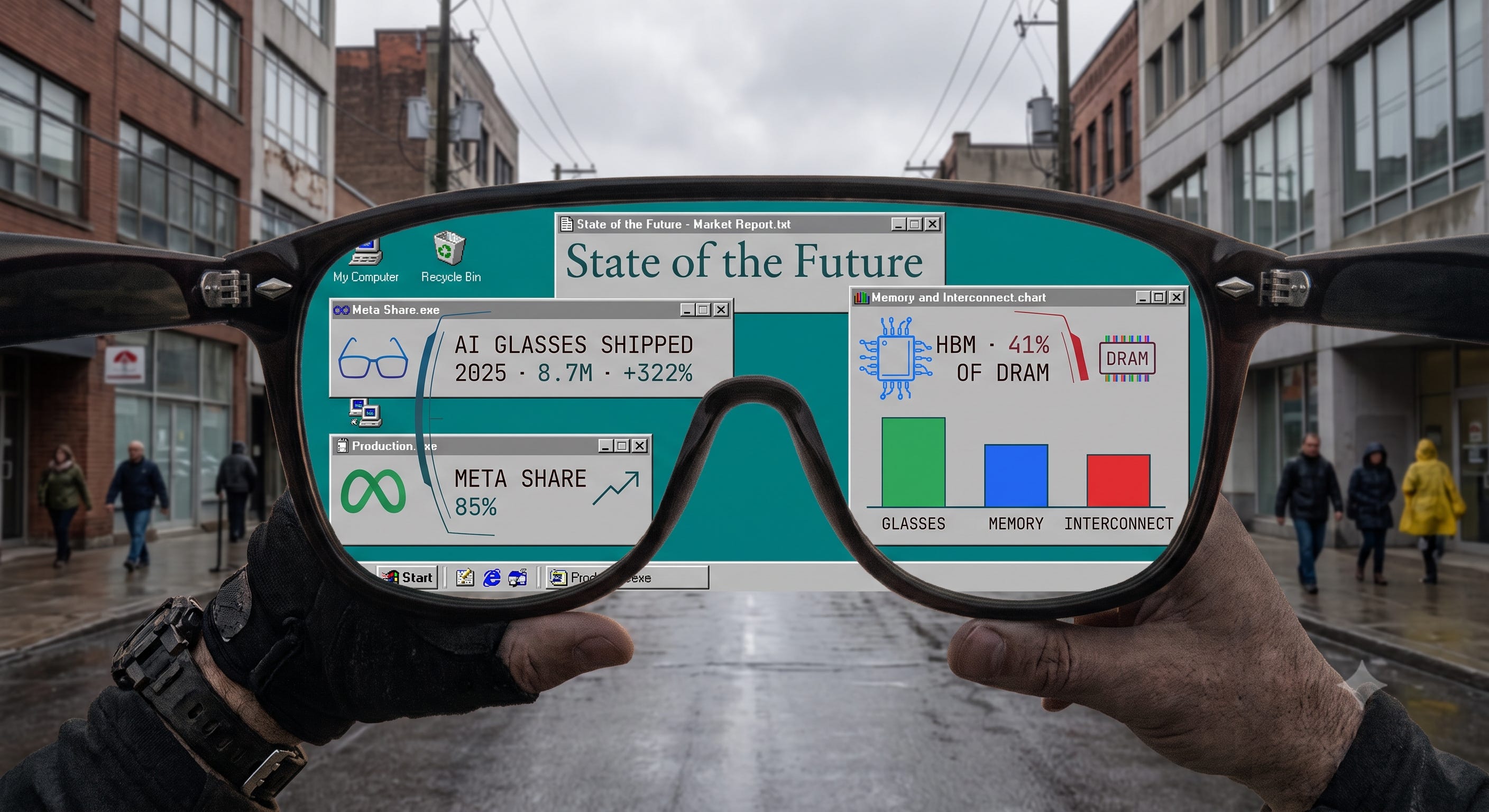
Big numbers. Huge volumes. 8.7 million pairs shipped in 2025. Up 322%, tracking at 15 million this year. Meta miles ahead, Apple doing a lot of R&D, Samsung and Google shipping products, generations arriving on a roughly yearly cadence, audio first, then camera, then displays. Not everything has a ChatGPT moment. Sometimes categories grow slowly.
VCs care about silicon, or deep-tech, or robots, drones. Because other VCs care. And that’s crufts. That’s the game. Nobody cares about AR. Or frogs (yet).
My bet is give it a year. For AR. Not for Frogs.
No one cares today. People will care tomorrow.
(The Book (patent pending), for newer readers: is a written-down list of my bets, each a fact, assumption, theme or thesis with a rough conviction number and a date, and under each item there’s a note on which one the week’s news moved, and which way. More to come on this + some sweet sweet monetization opportunities)
1. AI Training Data and Glasses
So with that in mind, I want to start with Meta’s glasses this week. A good time as ever. They had to push an update that switches the camera off if you physically tamper with the LED. Turns out people were paying to blind the light so they could film strangers who had no idea. Because humans are awful people. Humans man. Come on. Be Better. Then the next Meta prototype leaked: they call them “super-sensing” glasses that have Live AI running for hours instead of half hour, with camera and mics on all day, the assistant recording everything you look at, and the LED wasn’t lit, so no one knows if it was on or not. Seems both good and bad yes? Like all new technologies. It won’t all be TBPN. Nor The Guardian.
So Meta are first up, well Google Glass was really, but Meta now and soon the rest of the industry, all struggling to balance privacy with usefulness. I wonder if the camera is the rubicon though, or if society just accepts it the way it accepted search and social media capturing all our private data. My address is a small price to pay for Google Maps. And I’ve been burnt betting on privacy before, with Brave Browser and crypto more broadly, but maybe this time is different? First they came for the communists and i did not speak out…
First, a bit of context, because Meta has taken this a lot further than most people realise, and spent a lot more. Here, the highlights:
Reality Labs formed in 2020.
It’s burned $80bn+ since, and the number gets bigger every year, roughly $18bn in 2024 and $19bn in 2025. Mark says this year is the peak.
They bought CTRL-Labs, the wristband that reads the nerve signals in your arm, for $1bn in 2019
The bought Luxexcel, a 3D-printed smart-lens maker, in 2023.
Then 3% of Ray-Ban’s owner EssilorLuxottica, for $3.5bn last year.
Products:
Ray-Ban Stories, 2021: a toy.
Ray-Ban Meta, 2023: Meta AI baked in, does decent volumes considering the terrible battery life.
Orion, 2024: the see-through AR pair, still can’t build it at scale.
Ray-Ban Display, 2025: $799, a screen in the corner of your eye, and the CTRL-Labs wristband finally shipped as the Neural Band.
A new $299 product arrived a few weeks ago. So in 7 years, a nerve-reading wristband, a Belgian lens factory, a stake in the world’s biggest eyewear group and the best part of $90bn, all of it building to the always-on, super-sensing pair of glasses.
A camera that lives on your face and never switches off.
The megatrend was image sensors if you can believe it.
This is a real category now. 8.7 million AI glasses shipped in 2025, up 322%, on track past 15 million this year, and Meta owns about 85% of it, 7.4 million units off the Ray-Ban and Oakley lines.
Samsung unveils its first pair, the Galaxy Glasses, on 22 July, audio-only to start, with a micro-LED display version due in 2027. Google is in through Android XR. And a wall of Chinese vendors, Rokid, Xiaomi, Alibaba, already shipping, some with real displays.
So look, if you don’t think the lasers, waveguides and batteries are good enough yet, you might be right. But the beachhead is data collection.
As the open internet dries up as a training source, the scarce input becomes exclusive real-world data nobody else has, and a camera on millions of faces recording all day is the richest proprietary stream anyone has ever assembled.
Source: The Verge
The book:
[theme: ai-data-supply-stack] ↑ Ambient always-on capture is the most aggressive proprietary-data grab yet; as public web data runs dry, whoever owns the sensor owns the stream. Durable value = iexclusive, neutral, high-skill data.
[theme: ar-display-optics] ↑ ~60%, more likely than not and firming. Every camera-on-a-face needs a light engine, a combiner and a prescription lens, and the volumes above are the demand signal for that whole optical stack.
[theme: low-power-edge-compute] → ~76%. All-day glasses are a sub-watt problem. The reason Samsung ships audio-first and Meta’s Live AI caps at half an hour is the power budget rather than the ambition. The silicon that wins on-device is built for the constraint (event-driven, in-memory, TinyML-class), and glasses are becoming its most demanding device.
2. The Memory Supercycle
I’ve got a post coming soon on HBM and how expensive it is. Before that, note, Nvidia has shed about a trillion dollars of market value since mid-May, and alot of it rotated into the memory names, Micron and the rest. A really quick primer to take away:
Four things live under memory:
SRAM is the fastest and most expensive, and it’s actually on the compute chip itself mostly as fast access. It’s made on the logic process by the foundries, so the memory makers never touch it, and it has more or less stopped shrinking at new nodes, which matters in a minute.
DRAM is your working memory, the main pool, made by exactly 3 firms, Samsung, SK Hynix and Micron.
HBM is DRAM’s premium cousin: the same DRAM dies stacked 8 or 12 high on a logic base and bolted next to the GPU for bandwidth.
NAND is storage, the non-volatile stuff in SSDs. They share fabs, capital and, more and more, the same squeeze.
Building a single HBM stack eats the wafer capacity of roughly 3 conventional DRAM wafers, and it sells for 3-5x as much.
So every maker is redirecting wafers away from commodity DRAM into HBM, HBM has gone from 8% of DRAM revenue in 2023 to about 41%, some NAND lines are being converted to DRAM to chase the dragon.
And DRAM is up 90% in the first quarter, server DRAM up 60-70%, a price-fixing suit against the 3 makers filed in late June. Now Micron isn’t doing consumer at all. Your next phone and laptop are the collateral damage of a datacentre bidding war.
Underneath, it’s standard economics: supply and demand. 3 suppliers, sold out, demand vertical, prices spike, and it rebalances when HBM4 and HBM5 come through around 2028 and 2029. Interesting if you trade memory stocks. Less interesting to me, because it sorts itself out. What I’m watching is the structural stuff. If HBM is the expensive limit through 2028, the prize is any design that gets around it: HBM-light inference silicon that runs the bandwidth-bound decode step without the stacks (see SRAM-heavy designs like Groq and Cerebras, or new compute-in-memory, processing-in-memory, or processing in NAND).
Source: WSTS | TrendForce | Bloomberg.
Background: AI Chips, ComputeRAM and the Future of Data Movement (Jan 2026).
The book:
[assumption: hbm-bottleneck] ↑ ~68% and rising. My baseline had HBM at ~$25bn by 2030. It’s already near $60bn in 2026, so i lowballed it badly. Stale-baseline flag to myself: HBM at 41% of DRAM revenue means the “bottleneck relieves by 2027” line needs re-dating, and the alternatives-to-HBM cohort has a longer, richer window than i’d modelled.
[theme: hbm-free-inference-architectures] → ~68%, and this is where i’m actually looking. It’s the scarcity window that makes HBM-light decode silicon valuable as a hedge. The investable filter is narrow: decode/retrieval-optimised designs.
[assumption: tech-inflation-silicon-shock] ↑ ~82%. The 40-year deflation IT gave the world has reversed. This is the cleanest datapoint yet: memory prices up 90% in a quarter and consumer devices getting more expensive because AI is eating the supply. Tech used to be the thing that made everything cheaper every year. Now DRAM is bidding your phone up. The evidence_log just gets longer.
3. Nvidia Roadmap Slips because Copper
This is a good story to track and update priors on your scale up interconnect thesis. If you bloody even have one. SemiAnalysis reports Nvidia’s Kyber rack for Rubin Ultra has slipped to 2028, more than a year, on a very specific manufacturing problem with the PCB midplane. This is the “orthogonal backplane” that wires the NVSwitches together across 8 racks.
2 words to make it make sense: scale-up and scale-out.
Scale-up means stuffing more GPUs into a single rack-scale domain, all of them talking to each other at full bandwidth over NVLink.
Scale-out is the next ring out, tying those racks together into a datacentre over Ethernet or InfiniBand.
As clusters grow, the limit stopped being the GPU and became scale-up: how many accelerators you can wire into a single domain before the wiring gives out. Kyber was Nvidia’s attempt to wire a much bigger domain. But the wiring’s a bust. Roadmap delayed. This is why a great new chip doesn’t win. You need a better system.
The knock on effect is how this impacts on the timeline of: copper versus light. That backplane is copper, you can only push so many bits so far across a board before the reach and the heat beat you.
The solution is go optical, co-packaged optics that put the light source right next to the switch, and Nvidia and Broadcom are already shipping CPO switches for exactly this scale-up layer. The transition is: pluggables, then linear-drive, then co-packaged. and the volume co-packaged optics show up first inside these proprietary Nvidia and Broadcom fabrics, which is where Kyber would live. So here you see a flagship rack slipping a year on a copper midplane. Shorten the timeline of cooper being replaced.
Source: Tom’s Hardware (SemiAnalysis) |
Background: Photonic “Engines” for Data Centers (Feb 2026).
The book:
[thesis: scale-up-interconnect] ↑ ~68%. As clusters grow the durable toll is the scale-up fabric, the switches and retimers and optical I/O, and the accelerator matters less, Even if Nvidia loses GPU share, AMD, the custom ASICs and the hyperscalers all have to buy switches, retimers and optical I/O.
[theme: optical-interconnect-cpo-transition] → ~84%. Pluggable to linear-drive to co-packaged, with volume CPO confined to Nvidia and Broadcom scale-up fabrics first. The winner is silicon-photonics, forecast to go 43% > 76% of transceivers by 2030, plus laser and light-source supply. The packaging war over which optics format wins matters far less.
What else I’ve been reading
Nothing. Yet to read the below, will do over weekend

The VC cycle chases whatever concentrates capital fastest, which is why API-first wins the narrative even as it concentrates fragility. The harder question isn't what meme's next, but whether the next generation of infrastructure will be built to survive without a single point of failure, the way power grids and forest networks do. That's not contrarian; it's just how systems survive under pressure.